
Automatic Versus Manual Motorhomes Compared
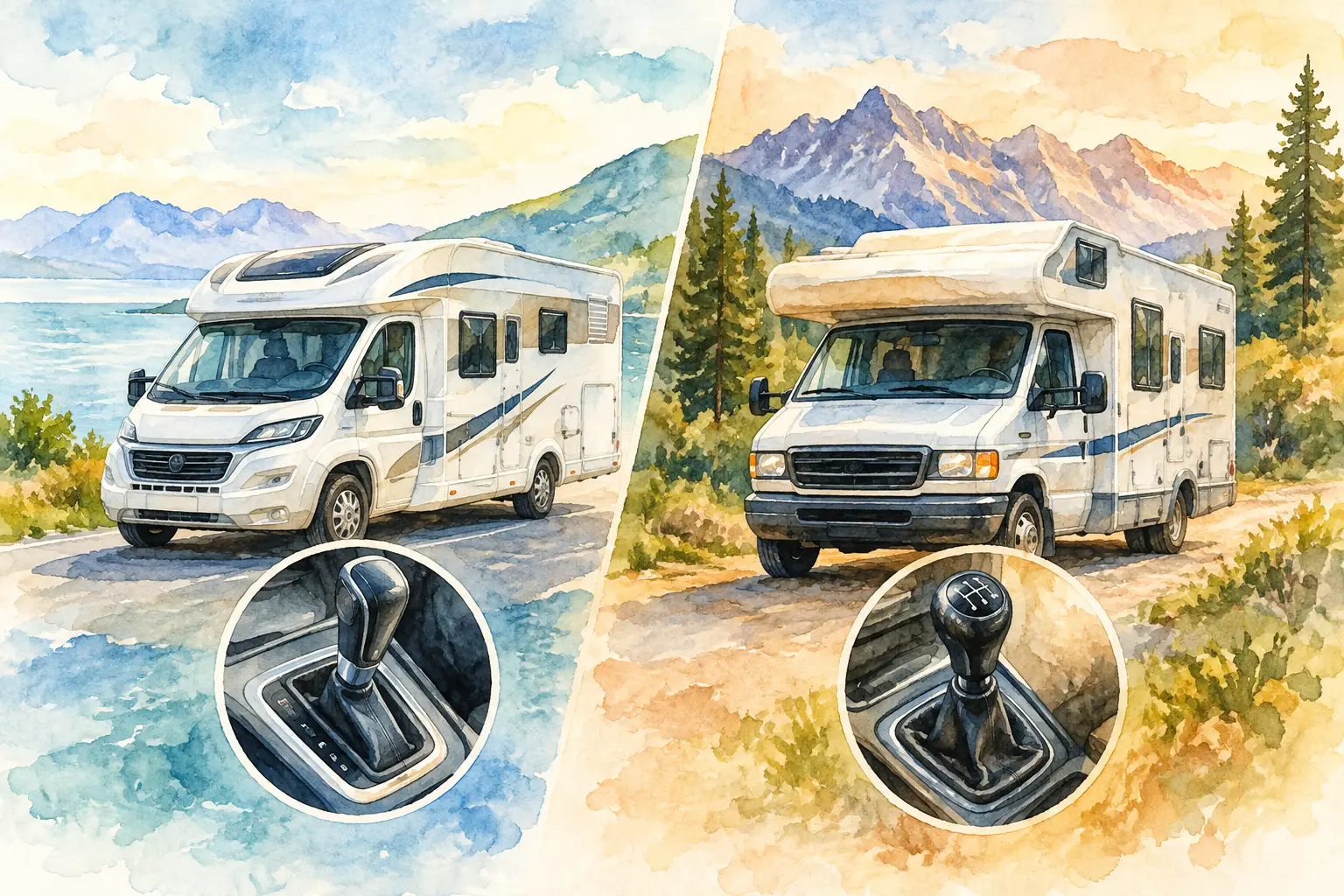
You may picture the Dolomites, the Croatian coast or a quiet Austrian lake. Before any of that, there is a very practical question at the driving seat: automatic versus manual motorhomes. The choice affects more than changing gear. It can shape how relaxed you feel leaving Bratislava, how fresh you are after a long motorway day, and whether mountain roads feel exciting or exhausting.
For many travellers, particularly first-time motorhome drivers, an automatic turns a large, well-equipped vehicle into something far less intimidating. But manual motorhomes still have their fans, and the better choice depends on your route, budget, driving habits and vehicle weight.
Automatic versus manual motorhomes: the real difference
The basic distinction is familiar. In a manual motorhome, the driver uses a clutch pedal and selects gears. An automatic motorhome changes gear itself, allowing you to concentrate on steering, speed, traffic and the road ahead.
That sounds simple, but a motorhome is not a small hatchback. It is taller, heavier and often carrying passengers, luggage, water, bicycles and everything needed for a proper holiday. It needs a little more anticipation when braking, turning and finding a parking place. Removing clutch work can make a noticeable difference to how calmly a driver manages all of that.
Modern automatic motorhomes are usually fitted with efficient, responsive gearboxes rather than the slow automatics some drivers remember from years ago. On a motorway, the changes are smooth. In stop-start traffic, they spare your left leg. On an uphill approach to an alpine campsite, they let you keep your attention where it belongs: on the road and the vehicle around you.
Why automatic is the easier holiday choice
An automatic transmission makes the strongest case when your trip includes long distances, busy cities or varied terrain. A route from Bratislava through Austria and Slovenia to Italy may involve motorways, tunnels, toll booths, narrow village streets and steep climbs in one holiday. That is plenty to take in without adding constant gear selection.
Less fatigue after a full driving day
Traffic around major European cities can be demanding, especially when you are unfamiliar with local lane layouts or road signs. With an automatic, you can move through queues and roundabouts without repeated clutch control. The benefit may seem small at first, but after three hours at the wheel it is real.
It also makes shared driving easier. One partner may be confident navigating an unfamiliar route but less comfortable with a manual gearbox in a larger vehicle. An automatic gives more people the confidence to take a turn behind the wheel, which makes the journey feel more like a shared adventure.
More attention for the road ahead
Driving a motorhome calls for good observation. You need to watch height restrictions, allow extra room at junctions, keep a safe following distance and be aware of crosswinds. Automatic transmission cannot do those things for you, but it reduces one source of workload.
This is particularly welcome on mountain routes. You can select a lower driving mode where available to control descents and maintain sensible engine braking, while still avoiding the repeated clutch and gear work of a manual. The key point is that automatic does not mean passive driving. It means fewer distractions while you stay fully responsible for speed and control.
A better fit for premium modern motorhomes
Many new motorhomes pair automatic gearboxes with useful driving technology such as reversing cameras, parking sensors, cruise control and advanced safety systems. Together, these features make a sizeable vehicle feel approachable without taking away the freedom of travelling under your own schedule.
At Flying Dog, the new 2026 LMC and Carado motorhomes and campervans are automatic for a straightforward reason: guests should spend their energy choosing the next viewpoint or lakeside stop, not worrying about a hill start in traffic. A detailed handover still matters, of course, because confidence comes from knowing the vehicle as well as enjoying its equipment.
When a manual motorhome still makes sense
Manual should not be dismissed as an outdated choice. For experienced drivers who enjoy being closely involved with the vehicle, a manual gearbox can feel more familiar and controlled. Some drivers prefer choosing the exact gear for a climb, descent or overtaking manoeuvre, although modern automatics offer manual-selection modes that narrow this gap.
Cost can also be a factor. Manual motorhomes are often cheaper to buy on the used market and may be available at a lower rental price in some fleets. If you are planning a short, uncomplicated trip on quieter roads and already drive a manual car every day, the saving may matter more than the convenience.
Availability deserves a mention too. Older or entry-level motorhomes are more likely to be manual, so a buyer with a specific layout, berth count or budget might find more options by remaining open to manual transmission.
The trade-off is simple: manual can offer a lower entry price and a familiar driving experience, while automatic generally delivers greater ease, especially over distance. Neither is automatically right for every traveller.
Consider your route, not just the gearbox
The best way to decide between automatic versus manual motorhomes is to plan the type of holiday you actually want. A couple touring flat countryside in Hungary will face different conditions from a family heading through the Alps with children, sports gear and several long transfer days.
If your itinerary includes city collections, busy borders, mountain passes, frequent campsite changes or driving shifts between two people, automatic is likely to repay its higher price in comfort. It is also a sensible choice if this is your first motorhome holiday. You will have enough new habits to learn, from checking vehicle height to levelling at a pitch and managing fresh water.
If you are buying rather than renting, think beyond the test drive. A manual may feel perfectly fine for twenty minutes on familiar local roads. Imagine instead a wet Friday evening after a long drive, when you are following sat-nav directions towards an unfamiliar campsite. That is often when an automatic feels most valuable.
What about fuel use and performance?
The old assumption that automatics always use far more fuel is no longer reliable. Modern transmissions are designed to select efficient gears and keep the engine working within a sensible range. Actual consumption depends much more on the motorhome’s weight, engine, driving speed, wind, hills, tyre pressures and how much equipment you carry.
A heavy right foot will use more fuel in either transmission. So will travelling at high speed, even where the road legally permits it. Smooth acceleration, sensible motorway speeds and leaving room to brake gently will usually make a greater difference than gearbox choice alone.
Performance is also less clear-cut than it once was. Manuals can give an experienced driver direct control, but a quality automatic responds quickly and takes the strain out of acceleration on gradients. Always drive within the vehicle’s limits and use lower gears or modes on long descents rather than relying solely on the brakes.
Confidence matters more than habit
Some drivers choose manual because they have always driven one. Others avoid it because they learned in an automatic. Both reactions are understandable, but neither should decide your holiday on its own.
Ask yourself who will drive, how far you will travel most days, and what will make you feel settled rather than tense. A motorhome holiday works best when the journey is part of the pleasure. If automatic transmission makes you more willing to explore a detour, share the driving or arrive at the campsite with energy left for a swim, it is not merely a convenience.
Before setting off, practise the essentials in a quiet area: mirrors, reversing camera, turning circle, braking distance and vehicle height. Learn how to use the gearbox’s lower settings and parking brake. Whether you choose automatic or manual, those few minutes of familiarisation can transform the first day on the road.
Choose the vehicle that lets you look beyond the windscreen with anticipation, not anxiety. The finest road trip is not the one with the most gear changes. It is the one where every mile leaves room for freedom, comfort and the next memorable stop.
