
European Driving Regulations for Motorhome Trips
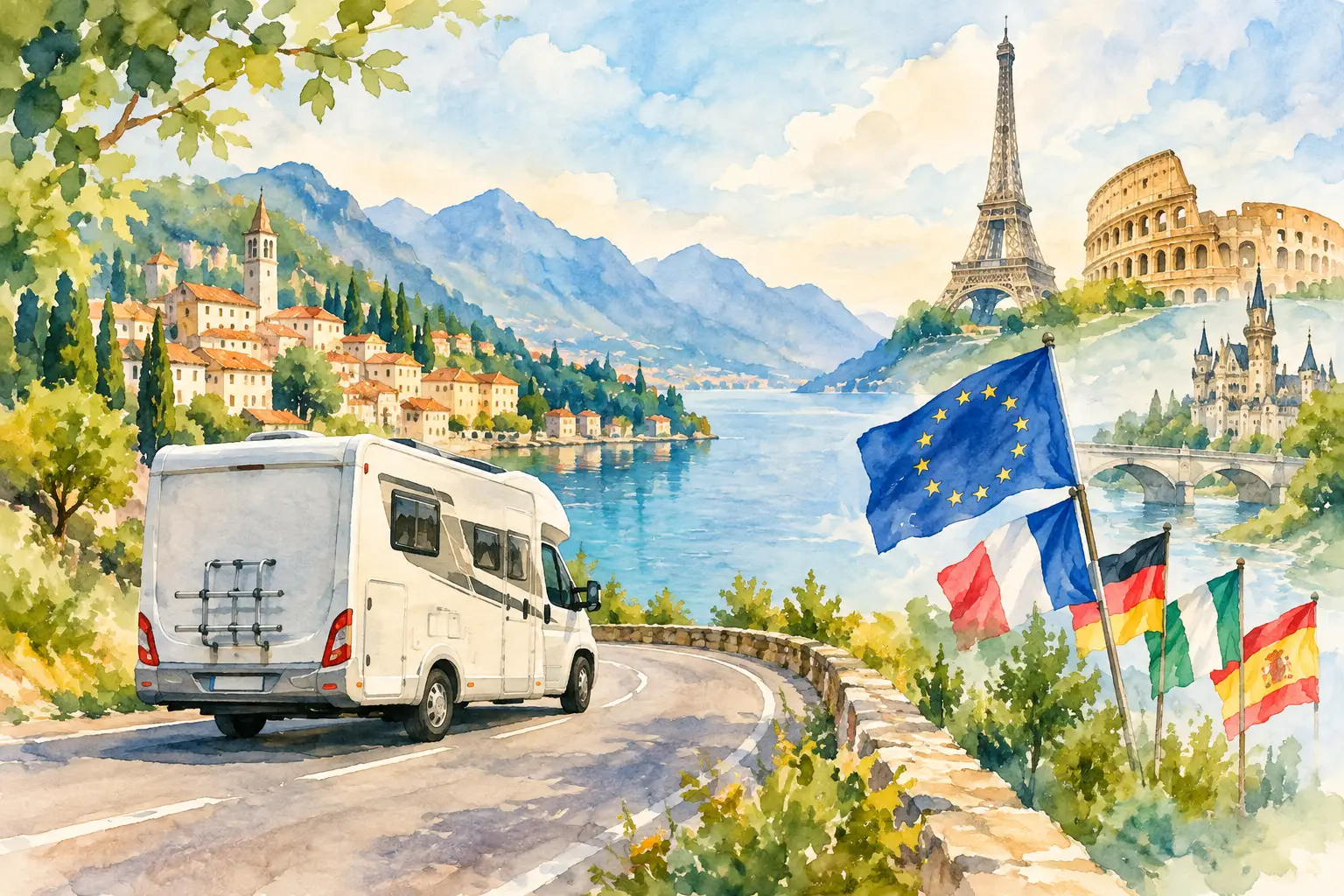
A motorhome holiday can take you from Bratislava’s city streets to an Alpine pass, an Italian lakeside pitch or the Croatian coast in a matter of days. That freedom is exactly the joy of road travel – but European driving regulations do not stop at the border. A rule that feels familiar in Slovakia may be different in Austria, Slovenia, Italy or Hungary.
For most travellers, preparation is straightforward. The key is to match your paperwork, vehicle weight, route and season before you set off. Then you can spend less time worrying at toll gates or mountain roads, and more time choosing the next beautiful place to stop.
European driving regulations: start with your vehicle
The first question is not where you are going. It is what you are driving. Most modern campervans and compact motorhomes are plated at or below 3.5 tonnes, meaning they can normally be driven with a standard Category B car licence. Larger motorhomes may need a different entitlement, and rules can vary according to the licence’s issue date and your home country.
Check the vehicle’s maximum authorised mass on its documents, not simply its apparent size. A spacious family motorhome with a garage, bikes, passengers, full water tank and luggage can be heavier than expected. Overloading is not a minor technicality: it can affect braking, handling, insurance and the legality of your journey.
If you are hiring, ask for the vehicle documents and make sure every intended driver meets the rental requirements. At Flying Dog, a proper handover is part of starting well: you should understand the controls, dimensions, fuel type, payload and what to do if a warning light appears before heading towards the first border.
Your licence and travel documents
Carry your physical driving licence, passport, rental agreement, vehicle registration document or certified copy, and insurance details. If you are travelling in a rented motorhome, the rental agreement is particularly useful because it confirms that you are authorised to take the vehicle abroad.
British photocard licences are widely recognised, but requirements for an International Driving Permit can depend on the country, the type of licence and where it was issued. Do not assume that a document accepted in one country will automatically satisfy every authority on a longer route. Check the current requirements for each country before departure, especially if your licence is paper-based, older, or issued outside the UK or EU.
Insurance deserves the same attention. Comprehensive Europe-wide cover is reassuring, but carry the insurer’s contact details and understand the excess, roadside-assistance process and any territorial limits. Keep these details accessible offline as mobile signal is not guaranteed in rural mountains or on cross-border routes.
Tolls, vignettes and low-emission zones
One of Europe’s biggest driving differences is how roads are paid for. In several countries, motorways use toll booths or electronic tags. Others require a vignette, which is a time-based motorway permit linked to your registration number or displayed on the windscreen.
Austria, Slovenia, Slovakia, Hungary and the Czech Republic are among the places where vignettes are common for vehicles within the relevant weight category. Buy the correct one before using a motorway, enter the registration number carefully for digital versions, and retain your confirmation. A small typing error can become an expensive fine.
Italy, Croatia and France often use distance-based toll systems, while local routes may offer an attractive, slower alternative. This can be ideal when your holiday is about villages, vineyards and lakes rather than arriving quickly. It is less ideal when you have a ferry booking or a campsite check-in time. Let the route suit the day you want, not only the cheapest option on the sat-nav.
Cities add another layer. Low-emission zones, congestion restrictions and limited-traffic areas can be enforced by cameras. Historic centres are especially likely to restrict vehicles, and a motorhome’s size makes an accidental wrong turn harder to reverse. Park outside the centre where possible, use public transport, or confirm that your accommodation has registered your number plate if it offers access.
Speed limits are not one-size-fits-all
Speed limits vary by country, road type, weather and vehicle class. A limit for a car may not apply to a motorhome, particularly if it is over 3.5 tonnes. Signs always take priority, as do lower limits for roadworks, tunnels, towns and mountain roads.
Even when the legal limit allows a higher speed, a fully loaded motorhome is more comfortable at a calmer pace. It needs more room to stop, catches side winds more readily and can feel very different after a day of rain. Leave a generous following distance, slow down before downhill bends, and use lower gears to control speed on long descents rather than relying only on the brakes.
Drink-driving limits also differ and are frequently lower than visitors expect. Some countries apply extremely strict limits, particularly for newer drivers or professional drivers. The simplest holiday rule is clear: if you are driving, do not drink alcohol.
Required equipment and seasonal rules
European countries may require safety equipment to be carried in the vehicle. The exact list differs, but common examples include a warning triangle, reflective hi-vis jacket, first-aid kit, spare bulbs, fire extinguisher and wheel chocks. A well-equipped rental motorhome should cover the practical basics, but it remains wise to check what is required for your planned countries.
Winter brings more variation. Austria, Slovenia, Italy and parts of other European countries can impose winter-tyre or snow-chain rules depending on the date, road conditions or region. Mountain passes may require chains even if roads lower down are clear. Do not treat chains as a decorative item in the garage: ask during handover how they fit, and practise understanding the process while you are warm and parked safely.
For a summer trip, remember that the weather can still change quickly in the Alps or Dolomites. Heavy rain, fog and sudden temperature drops are reasons to slow down or change the route, not to push on because the campsite is only another hour away.
Parking, overnight stops and wild camping
A motorhome gives you independence, but it does not mean you can stay anywhere overnight. The difference between parking and camping is important. Sitting in a legal parking bay for a rest may be permitted where setting out chairs, an awning, ramps or barbecue equipment is not.
Rules on wild camping and overnight motorhome stays vary greatly by country, municipality and protected area. Some places tolerate a single night of discreet rest; others prohibit it or restrict overnight parking through local signs. Coastal areas, national parks and popular lakes are often closely monitored.
The reliable option is to use official campsites, motorhome stopovers or designated parking areas. They also solve practical needs: fresh water, waste disposal, electricity and a more relaxed evening. If you do stop outside a campsite, leave no trace, keep noise down and never empty grey water or toilet waste anywhere except an approved disposal point.
Plan borders, fuel and the small details
Many European borders are easy to cross, but that does not mean they are always invisible. Temporary checks can happen, so keep documents close rather than buried under holiday luggage. If you are taking a dog, make sure its microchip, rabies vaccination and pet travel documents meet the rules for every country on your route and for your return journey.
Fuel labels are standardised across much of Europe, yet pumps and payment systems still differ. Confirm whether your motorhome uses diesel, note the height and width before entering a car park, and avoid blindly following sat-nav directions down narrow village lanes. Set the vehicle dimensions in the navigation system if possible.
Before each driving day, take two minutes for a walk-around. Check tyres, lights, doors, storage lockers and anything mounted outside. Secure loose items inside the living area as well. A motorhome should feel like freedom on wheels, not a collection of things waiting to fall over at the first roundabout.
The best European road trips leave room for a scenic detour and a long lunch, but they are built on sensible preparation. Know the rules that apply to your vehicle, buy the right road permits, respect local signs and give yourself time. Then the journey can feel exactly as it should: comfortable, confident and wonderfully open-ended.
